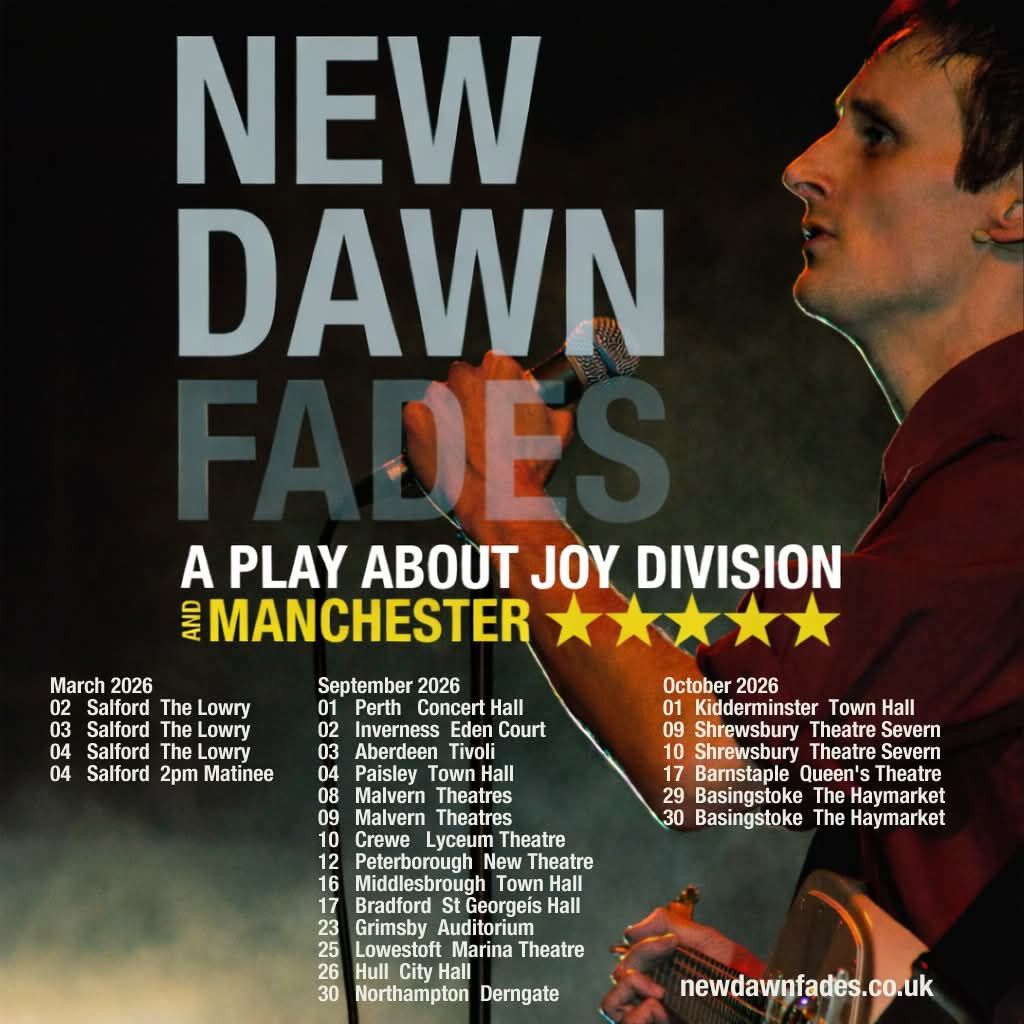
New Dawn Fades has been on several national tours as well as three runs in the West End. Now the production is coming home to Manchester and will surely please all Joy Division completists and casual observers alike. New Dawn Fades is a captivating theatrical work that tracks the trials and tribulations of the legendary Manchester band Joy Division. The play has been around for a long time in many incarnations, playing fringe and some mainstream venues for over a decade prior to Tin Orb taking over the production. Since they did so, it has toured nationally to critical acclaim, playing no less than three times in the West End’s prestigious Bloomsbury Theatre. Josh plays the lead role of Ian Curtis and portrays him brilliantly.
When I first saw it at the Bloomsbury Theatre, I was expecting flying scenery, tables, chairs, recording studio equipment and all manner of props augmenting the acting. I was quite surprised by the sparse nature of the production, for there was no set at all, apart from a virtual backdrop that showed imagery of the legendary period, including footage of that infamous concert at the Free Trade Hall and other film denoting the era that this band experienced and shared with the public at large, providing hits such as Love Will Tear Us Apart and Transmission. I spoke to Josh quite candidly about his remarkable performance.

Josh, it’s great to meet you and I thoroughly enjoyed your performance in the West End. Portraying Ian Curtis is no mean feat — a sad and complex character to say the least. How did you go about developing the role? Was it pure mimicry, or did you employ a method-based approach to truly embody the spirit of Curtis?
“I listened to Joy Division on repeat when I was younger and Ian was one of my idols. I think I felt like I knew him, as I’m sure many did, because of his deeply ensouled lyrics, his unnerving authenticity, and, well, I guess he just activated something within me. Artistically, spiritually, something. So, I’ve always felt close to Ian. I also buried my nose into the literature available on Ian. Most helpful were Deborah Curtis’s Touching From A Distance and Peter Hook’s Unknown Pleasures: Inside Joy Division. My main operation was in extricating the man from the myth that surrounded him and I felt the best way to get a sense of who he actually was – as opposed to the romanticised image that follows him posthumously – was in listening closely to the perspectives of two people who knew him closely.”
“We all see or receive different sides of a person, depending on our relationship with them, and it’s true that Debbie and the band each received their own version of Ian. I wanted to find those crossover points in people’s accounts of him, to ascertain what remained consistent in his personality, while honouring all of his multi-dimensionality. Turns out that Ian was something of a shape-shifter and not easy to pin down as any one thing – arguably as all human beings are – but, at times, he embodied this chameleonic personality to the extreme. That’s something I found fascinating to explore: that he could be, to some degree, a different person depending on the company, that there was always something hidden in him, or something held back, or that you never could glimpse the full extent of whatever was moving
behind his brooding veneer.”
“That approach was incredible putty when it came to playing him. Resisting any solid definition has enabled my portrayal to be an alive and endlessly evolving journey into the vast country that is Ian Curtis. As for what lay behind that brooding veneer – well, I always had a feeling we got closest to the truth of Ian’s soul when he was actually performing. There was something shamanistic in the way he performed – as if he was straddling both realms and channelling something far beyond himself and, at the same time, completely true to himself. So, when it came to performing like Ian, I’m less focused on being a perfect mimic. Rather, I let myself slide out of view, and like Ian, allow myself to be thrown around and contorted by whatever psychosomatic impulses are stirred up in the moment. It seems to do the trick!”
This is far from a naturalistic piece; it’s a stylised tapestry that weaves surrealism in a distinctly Pinteresque, existential register, whilst embracing belt-and-braces humour and the occasional theatrical gag. Do you feel that this delicate blend of comedy, pathos and tragedy was the correct compass for the production? The audience laughed, howled, cried — and when the group burst into song there was rapturous applause. It feels like a small piece of magic that defies categorisation while echoingmultiple traditions. Could you explain the process of blending those genres in your own way, and tell me what it was like weaving that magic with such an illustrious and diverse cast
“The show certainly resists easy definition. It breaks the fourth wall as a matter of principle and swerves from near-absurdity to sobering scenes of heartbreak, reconciliation and reminders of the human cost behind the Joy Division story, almost without blinking. Essentially, it endeavours to celebrate the entire spectrum of human experience involved in this pivotal story of Manchester’s music history. There is tragedy here, for sure. But there is also hope, humour, and a great beating heart. It’s a love-letter to Manchester and, as any good love-story goes, it’s a wild emotional ride. Audiences should be prepared to laugh and to cry – sometimes both at the same time.”
“Over the last couple of years, I’ve also seen the show evolve. It’s becoming braver, more daring, and is opening itself up to fresh possibilities. Crucial to that creative engine are the cast itself and the directorship of Lauren Greenwood. All of the creatives on-board commit their heart and souls to the ongoing refinement of this story. Last year’s production felt like we stepped even closer to fleshing out and making more visible the complexities of each character, and I’m excited for what the near-future holds for the show’s continued evolution.”

You’ve graced an array of prestigious theatres, including Cheltenham Everyman and the City Varieties in Leeds. What was it like transporting the soul of Manchester into the heart of the West End for the first time at the Bloomsbury Theatre? Did the audience react differently from Northern crowds? And how did it feel to bask in sell-out performances crowned nightly by standing ovations?
“Full disclosure: I’m Northern here, therefore somewhat biased. But, seriously though, while
there has been something especially heightened about performing to one of the homecoming
crowds (whether in Manchester, Bury or Macclesfield), our receptions have been incredible wherever we’ve ventured. That’s testament to the impact of Joy Division on the cultural psyche, of course, but also to the show itself. Somehow, the show seems to fill a collective need – for grief, for joy, for shared recollection of times gone by though still very much alive within us– and the moments where we, as the band, perform as one, seem to take that to its zenith.”
“That’s definitely a pinch-me-I’m-dreaming moment, to be resuscitating famous performances of Joy Division’s in front of a live audience, totally engrossed and totally there with us, and it’s made all the more special to share it with Gaz Hayden, Garient Lyons, and Jack McGarry, each wonderful musicians and actors in their own right. To share that connection with the crowd and with fellow castmates who have put their blood, sweat and tears into the art, there’s nothing else like it. It’s exactly what an actor lives for!”
Within the production, you perform no fewer than four classic Joy Division tracks. What was your approach to the vocal performance? You are uncannily reminiscent of Ian Curtis, yet it never feels like simple mimicry. Did you draw upon method techniques to sculpt his voice, posture, distinctive Mancunian dancing and that effervescent, if slightly melancholy, demeanour?
“I think my aforementioned sense of closeness to Ian helped massively. From there, I just spent more time with him. I read his writings and charted his life, attempting to figure out how his mind worked or how he perceived himself and the world he inhabited. To be frank, there were a lot of moments of recognition in reading about him, where parts of my own internal world felt in close affinity to his.”
“I’d like to tell you I had a huge amount of highfalutin dramatic techniques up my sleeve, but the truth is I simply practised his voices whenever I could, whether his quite mild-mannered, even non-threatening Northern drawl, or his dark bass-baritone tones when singing. On my first year with the show, I did spend quite a bit of time mimicking his dance moves in my bedroom mirror. That really helped ground Ian into my body. I was also a regular dancer with Five Rhythms, a dynamic movement practice. There are two rhythms in that practice, “staccato” and “chaos”, which allowed me to explore uninhibited the dynamics of strong, sharp and seizure-like movements (staccato) and the wild abandon of flailing limbs (chaos); both of which must have entered into my Curtis dancing.”
“Mostly though, the best success I’ve had is when I don’t try to be a perfect replica of Ian, lest I become too mechanical. There’s a line in the show, beautifully delivered by the inimitable Nicholas Eccles, as Martin Hannett, that puts it nicely: “it’s the spirit I want, your spirit”. And that’s really where I lay my focus now, in trying to harness the spirit of Ian, letting that lead from the inside-out and trusting whatever comes through.”
On stage you share a powerful synergy with Brian Gorman, who portrays Tony Wilson brilliantly. How did it feel voicing Wilson’s words in front of him, and what was he like to collaborate with? In many ways he serves as narrator — the Salfordian maverick behind Factory Records who played such a pivotal role in the Joy Division and later New Order story.
“Sometimes I don’t know where Brian Gorman ends and Tony Wilson begins. I’m joking somewhat, but like all good jokes there’s a grain of truth in them. Brian’s one of the main reasons people keep coming back. His portrayal of Tony is uncanny. He also has a way of charming the crowds that I don’t think would be far from the man himself. Likewise, he has a talent for ad-libbing, much like Wilson I imagine, which warms the audience to him and sometimes means we actors have to stop ourselves from ‘corpsing’ (laughing out of character on-stage). New Dawn Fades is Brian’s baby and he’s been raising it for over a decade now,and so, it seems only fitting he should play the role of Wilson as narrator, for in a very real sense, Brian is walking us through the product of his own imagination.”

You work very closely with Lauren, who plays Debbie, Ian Curtis’s wife. It’s an intricate and delicate relationship. How did you build that connection on stage, and did you undertake extensive research to understand these real people and who they were at the time?
“Lauren and I worked very closely to establish a relationship between our characters that honoured the totality of them both. We didn’t want to flinch when it came to looking honestly at those sides of Ian that were less savoury. Or to downplay them. Neither did we want to fall into a two-dimensional casting of a loveless marriage, or place one character as the ‘antihero’ and the other as ‘victim’. The fact is that these two were all-too-human people, entangled together, trying their best despite being overwhelmed by their burdens, and we really wanted to explore how their love was challenged and transformed under the pressure of all of that.”
“Something in that imperfect love felt very real, relatable, and essential. Quite often the woman’s side is left out or overlooked in the telling of the Joy Division story. I’m not just talking about Debbie, of course, I’m also talking about Annik Honore. To challenge this, it was of the utmost importance that Debbie appeared as more than the simple ‘woman left at home’. Lauren does an incredible job of bringing Debbie to life in all of her rich complexity, resilient spirit and faithful heart, despite being a woman very much pushed out of view by the band’s increasing success. My favourite masterstroke of Lauren’s is in how she shows Debbie’s strength precisely in her moments of vulnerability – by no means an easy thing to do!”
The four Joy Division performances feel utterly authentic, and the chemistry within the band is impeccable. Did you study the original recordings in depth to capture that atmosphere? From a viewer’s perspective it hits the mark perfectly — how do you feel about the way it’s turned out?
“The secret to the success is that we allowed ourselves to have a lot of fun when performing together. We would literally meet all rehearsals of the band’s performances together as if we were a real band practising in an old, dingy rehearsal space. We tell silly jokes, jam and goof around. We make fun of ourselves and one another. Just as you imagine any band would. It also helps that each of the actor’s playing band members are accomplished musicians themselves. That lived-in experience just elevates the authenticity of the whole thing. Each of those actors (Jack McGarry, Garient Lyons and Gaz Hayden) have each been close studies on their characters too – not only evoking their personalities with deceptive ease throughout the play’s narrative, but also looking closely at their personas on-stage.”
“As a group, it was important to us to make sure to study the band’s dynamics, not only as a band in performance, but as a group of young lads, making it up as they go, largely clueless about most things except their chosen instrument, but driven to success by an unflagging ambition. Even now, as we go up to perform, it feels as though we’re those young lads, making it up as we go, having a whale of time, and enjoying the dream as it happens in front of our eyes.”

It’s said you’re now recording a vinyl project with Love Will Tear Us Apart at its centre, collaborating with members of The Clash, Level 42, The Blockhead, The Fall, Modern Romance, Eurythmics and Peter Hook’s Hacienda Classical, somewhat of a supergroup augmenting the cast recording. Are you looking forward to that experience?
“Looking forward would be an understatement. It’s another one of those pinch-me-quick moments. It feels very much like I’m dreaming a dream I didn’t even know I was dreaming. Never would have the younger Josh, walking with his headphones plugged in, brooding to Joy Division and mouthing the words, have imagined he’d be recording them some day – especially alongside such legends!”
You’re bringing this body of work home to the legendary Lowry Theatre — the National Theatre of the North. Are you excited to perform in such an iconic venue?
“I remember being transported by theatre shows at the Lowry when I was only young. It was one of those formative experiences that gave me the idea to become an actor. This is the type of theatre you imagine when you think of the magic, the wonder, the suspension of disbelief, and the ‘entering into another world’ that only theatre can produce. There’s plenty of talk about manifestation and following your dreams out there. I’m taking this as my confirmation of that. Safe to say – it’s an honour to be performing there.”

This production is stripped bare: no frills, no props, no conventional set — only evocative visuals that amplify the performances. How do you feel about Tin Orb’s bold minimalist approach in this new incarnation of New Dawn Fades, a version that has received critical acclaim across Britain? Do you see minimalism as a masterstroke, or would you ever be tempted by a more traditional staging?
“Stripped bare is a great way to describe the show. Not just in its set dressing. Or lack of it. Everything’s peeled back right to its underlying essence. It kind of feeds into the leading ethos of the show at the moment, that the times are presented exactly as they were, uncensored and unapologetic. The minimalism also serves the play’s multi-dimensionality. We’re very much time-travelling (not just to the late seventies) and jumping from location to location, vignette to vignette, in the show’s storytelling. That minimalist approach allows us to bend time and to seamlessly enter into differing character’s perspectives. The mainstays on the stage are the band’s travelling flight-case and their instruments, ready in position. That points to the story’s central beam, holding it all together: the shared dream of Joy Division that is somehow coming to fruition.”
Peter Hook introduced the song at the Royal College of music during The sent outproduction. He was visually moved by the body of work. What was it like meeting one of the main protagonists behind the songs and how did you guys feel about meeting Peter. As he played him in the show, it must’ve been a poignant and emotional moment. What was his response and how do you feel about getting an endorsement from the Legend himself?
“It was my first experience of being somewhat starstruck and speechless as a result. Honestly, I wished I had chance to speak to him more, as I met him just moments before going on-stage. If I recall correctly, on account of his shoulder injury, he asked if I might move a chair for him so he could watch the show. Only I didn’t quite hear what he said and I’m pretty sure I just goofily smiled and waved. Anyway, there’s always next time, isn’t there? (Please be a next time).”
“It was incredibly touching that he’d come to see the show. I’m happy to say that I don’t think a finer actor could have played Hooky, as Gaz Hayden (the amount of forethought and energy he commits to the craft is unreal). Of course, it was totally surreal performing scenes of a story all-too-familiar to the real Hooky. It was a very strange experience, when performing Shadowplay, of the lines between art and life blurring, with the awareness of Peter watching; it drove home the reality of what we were doing. This isn’t just a compelling story, it’s somebody’s actual lived life, and I felt the emotional significance of that – it was all very humbling and reaffirmed the necessity of taking seriously the play we do as actors.”
“In telling the Joy Division story and portraying Ian, I always want to honour his and their memory, and I’m pleased to say I think we’ve managed that. I can’t thank Peter Hook enough for turning up and supporting the show as he did. It demonstrates just how much of an impact the show is making across the UK. Here’s hoping our paths cross again!”

Josh, thank you very much for taking time out to speak to the punk site about this innovative, critically acclaimed, excellent production of New Dawn Fades. Ian Curtis would be proud. Enough said.
The post Discussing Ian Curtis & New Dawn Fades With Josh Lonsdale Ahead Of Homecoming Run appeared first on ThePunkSite.com.